
Best Astellia Private Servers 2026 - Astels & Revival Guide
Find the best Astellia private servers in 2026. Collectable Astels, client versions, rates, cash shop policy and server stability, ranked by real player votes.
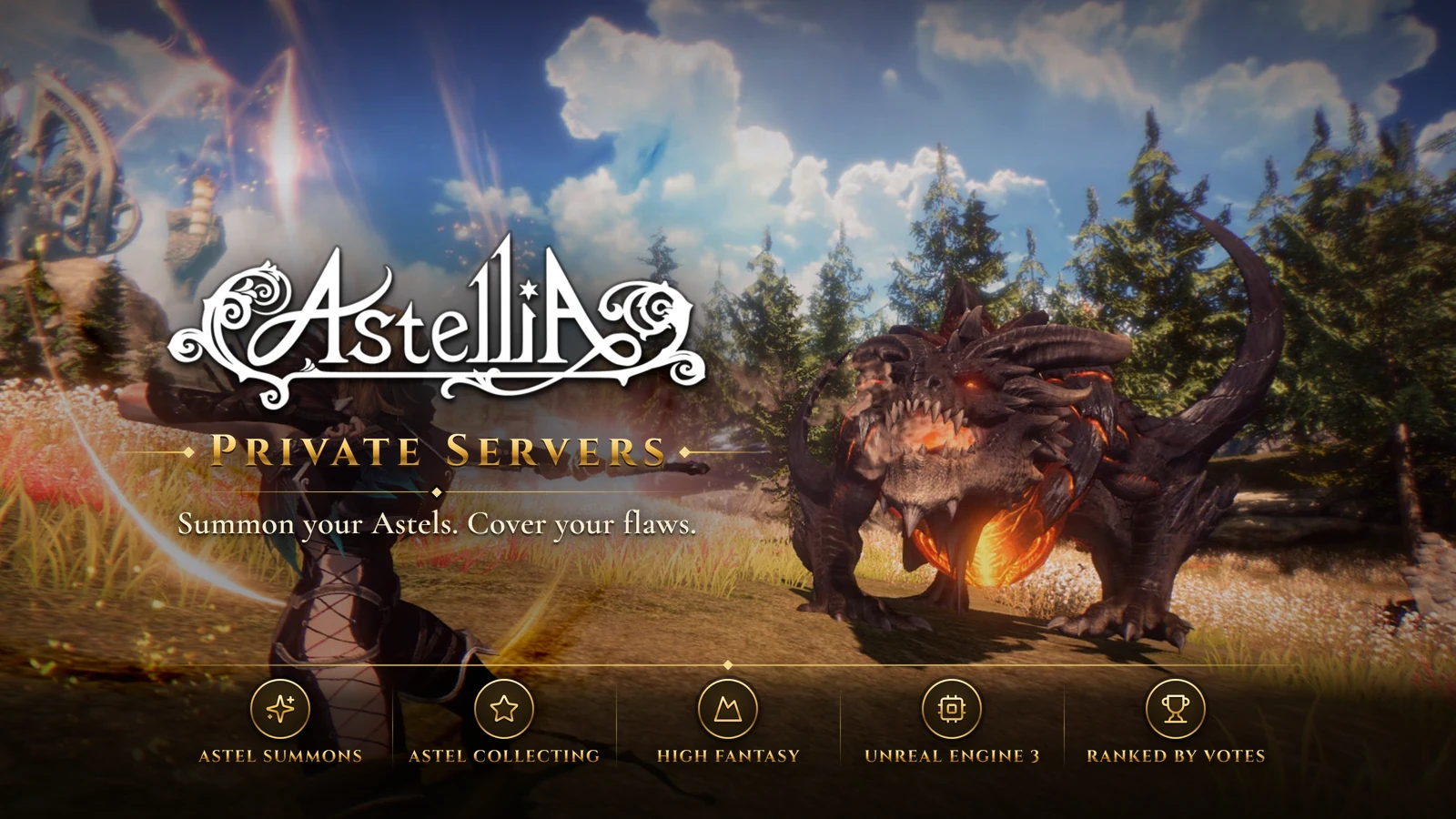
Astellia is a high fantasy MMORPG from Korean studio Studio 8, published by Barunson E&A and built on Unreal Engine 3. It launched in Korea in late 2018 as a free-to-play game and in North America in the summer of 2019 as a buy-to-play release. Its official life was short and turbulent: Barunson stepped away by April 2020, a free-to-play version called Astellia Royal arrived on Steam in March 2021, and the Western versions closed in October 2021. A blockchain relaunch, Astel of Atra, ran only from December 2022 to February 2023, and by May 2023 the Korean website was gone as well.
With no official version left, a fan-run server is the only way to play Astellia today, and any server you find will be a small project. This guide covers what the game was about and what to check before you trust one with your time.
Astels: Companions You Collect
The game is named for its Astels, summonable companions that you collect over time. You call them into fights to cover your character's weaknesses or to push your strengths further, so a fragile character can bring extra protection while a sturdy one can add more damage. Building and choosing your Astel lineup is the long-term project that set Astellia apart from other MMOs of its time.
Around that system, Astellia offered a familiar high fantasy MMO: questing through a large world, group content and gear progression. The Astels gave that structure its personality, and they are the main reason players still remember the game.
What to Look For in an Astellia Private Server
Which Version It Is Based On
Astellia existed as a free-to-play Korean game, a buy-to-play Western release, the free-to-play Astellia Royal and the blockchain-based Astel of Atra. A fan server is built on one of these, and they differ in shop, progression and features. Check which one, and which language the client uses.
Astel Collection and Balance
Because Astels drive both progression and power, look at how a server lets you obtain them, how many are available and whether any are locked behind payments. A server that sells the best Astels for cash has hollowed out the game's core.
No Token Economy
The game's last official form tied Astels to NFTs and cryptocurrency. A fan server cannot offer those official rewards, and any promise of crypto earnings is a reason for caution rather than a feature.
Rates and Content
Compare experience and drop rates with how much content the server actually has. On a small fan server, fast rates can burn through everything quickly, and missing dungeons or quests show up sooner.
Stability and Community
A game with a short official life has a small fan base. Check how long the server has been up, how the team handles bugs, and whether enough people are online at your hours for group content.
Faithful Copy or New Direction
A fan server can try to recreate one official version as closely as possible, or use the game as a base for its own changes to rates, Astels and the shop. A faithful copy suits players who miss the original; a reworked one may suit players who want to see the game's ideas taken further. Read each server's description with that difference in mind.
Getting Started
Confirm which version a server runs and how it handles Astels before you invest time. Pick a class, then plan your first Astels around what that class lacks. Keep your expectations realistic for a small scene. If a server earns your time, vote for it. The ranking below lists the Astellia servers players vote for here, and it starts again every month.
Top Astellia Private Servers (2026)
No Astellia private servers are listed yet. Servers added to the site appear here, ranked by this month's player votes.
Frequently Asked Questions
What is the best Astellia private server in 2026?
No Astellia private server is listed here yet. The first ones to be added appear in the ranking on this page, ordered by this month's votes.
How many Astellia private servers are there?
None are listed here yet. A Astellia private server added to the site appears in this ranking as soon as it is active.
How often are these rankings updated?
The ranking is read live from this month's vote counts, so it changes as players vote. Its order last changed on October 13, 2026.
How We Rank Astellia Servers
Servers are listed by the number of counted votes they received this month, most first. Each player can vote for a server once every 24 hours, and every vote is checked for VPNs, proxies and bots before it counts. Vote counts start again from zero on the 1st of every month, and a server that goes 14 days without a counted vote is hidden from the lists until it gets one. Player reviews and ratings are shown on each server's page but do not change its position. How rankings work has the full rules.
- Ordered by this month's counted votes
- One vote per server every 24 hours
- VPN, proxy and bot checks on every vote
- A fresh start on the 1st of every month