
Best Atlas Servers 2026 - Pirate PvP, PvE & Grid Size Guide
Find the best Atlas servers in 2026. PvP vs PvE, map and grid size, rates, company limits, ship rules and wipes explained, ranked by real player votes.
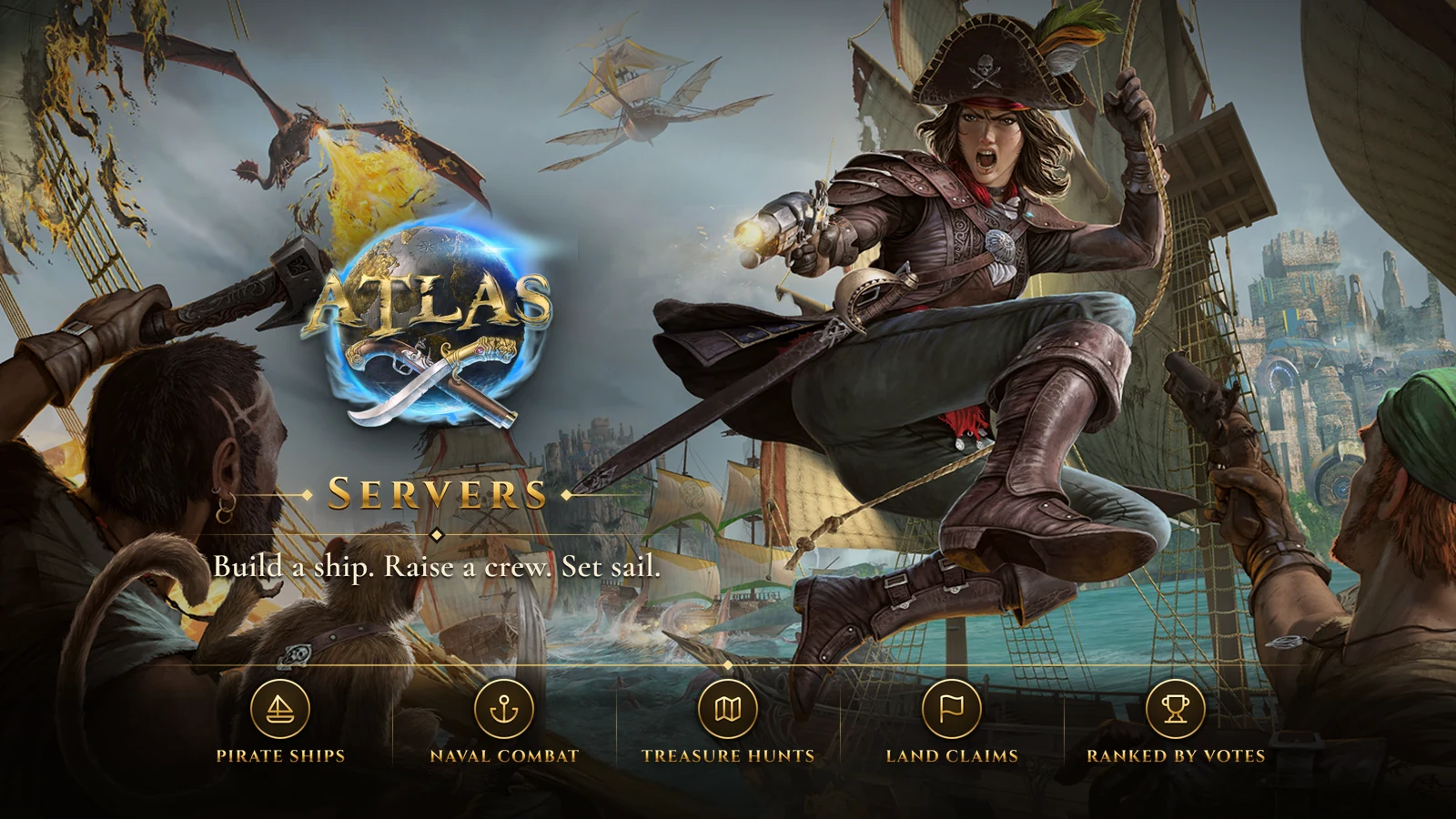
Atlas is the pirate survival game from Grapeshot Games, a spin-off of ARK developer Studio Wildcard, published by Snail Games USA. It entered early access in December 2018 on PC and Xbox One with an ambitious idea: a world of islands and open sea split into a grid of connected regions, built to hold enormous numbers of players at once. You survive, build ships, form a company, claim land and sail out to see what is over the horizon.
Much of today's Atlas scene plays on unofficial servers, where owners build their own maps from those grids at a size they can actually fill, and set their own rates and rules. Those choices matter a great deal in a game this large and this slow.
Life on the High Seas
Survival in Atlas goes beyond hunger and thirst: you track hydration and four separate vitamin levels, so a pirate living on one kind of food soon falls ill. You gather, craft and build bases on claimed land, tame some of the animals you find, and work toward the real goal - ships. A good ship is a long project of hull, decks, sails and cannons, and sailing it well takes a crew.
Players band together in companies that claim land, run shipyards and sail as fleets. Treasure hunting gives a reason to explore, and the sea is where the drama happens: storms, sea monsters and, on PvP servers, other crews who would rather take your ship than build their own.
What to Look For in an Atlas Server
PvP or PvE
On PvP servers other players can attack at any time, and naval battles, boarding and raids on land claims are part of everyday life. PvE servers let you explore, build and sail without that threat. Some PvP servers add protection windows or rules against attacking offline companies, so read the details before you build a shipyard.
Map and Grid Size
Unofficial servers run maps of very different sizes, from a handful of grids to large multi-region worlds. A map that is too big for its population feels empty, while a compact one keeps companies in contact and makes trade and conflict happen. Check the grid count against the number of active players.
Rates and Shipbuilding Pace
Progression in Atlas is slow at default settings. Servers often raise gathering, experience and taming rates, and some speed up ship construction. Boosted rates get you sailing sooner; settings close to default make every finished ship feel earned. Choose the pace you can keep up with.
Company Size and Claims
Company caps and claim limits decide whether small crews can hold their own. Large companies with no claim limits can lock up the best islands; tighter limits leave room for newcomers. Look at how alliances are handled, too.
Fleet Limits, Wipes and Admins
Fleets, bases and tamed animals all cost server performance, so good servers set limits on ships and structures and restart on a schedule. Ask how often the server wipes and whether it announces wipes in advance. Then look for admins who answer on Discord and restore ships lost to bugs.
Getting Started
Choose PvP or PvE first, then a map size and rate level that suit your crew. Join a company early, since Atlas is hard alone, and learn to sail a small boat before you sink your resources into a galleon. Read the server's rules on claims and raids on its Discord. The ranking below lists the Atlas servers players vote for here. Vote for the server you sail on - rankings start again every month, so the list follows where crews are active now.
Top Atlas Servers (2026)
No Atlas servers are listed yet. Servers added to the site appear here, ranked by this month's player votes.
Frequently Asked Questions
What is the best Atlas server in 2026?
No Atlas server is listed here yet. The first ones to be added appear in the ranking on this page, ordered by this month's votes.
How many Atlas servers are there?
None are listed here yet. A Atlas server added to the site appears in this ranking as soon as it is active.
How often are these rankings updated?
The ranking is read live from this month's vote counts, so it changes as players vote. Its order last changed on October 13, 2026.
How We Rank Atlas Servers
Servers are listed by the number of counted votes they received this month, most first. Each player can vote for a server once every 24 hours, and every vote is checked for VPNs, proxies and bots before it counts. Vote counts start again from zero on the 1st of every month, and a server that goes 14 days without a counted vote is hidden from the lists until it gets one. Player reviews and ratings are shown on each server's page but do not change its position. How rankings work has the full rules.
- Ordered by this month's counted votes
- One vote per server every 24 hours
- VPN, proxy and bot checks on every vote
- A fresh start on the 1st of every month