
Best Dark Age of Camelot Private Servers 2026 - Freeshard & RvR Guide
Find the best Dark Age of Camelot private servers in 2026. Freeshard eras, realm balance, RvR and crafting explained, ranked by real player votes.
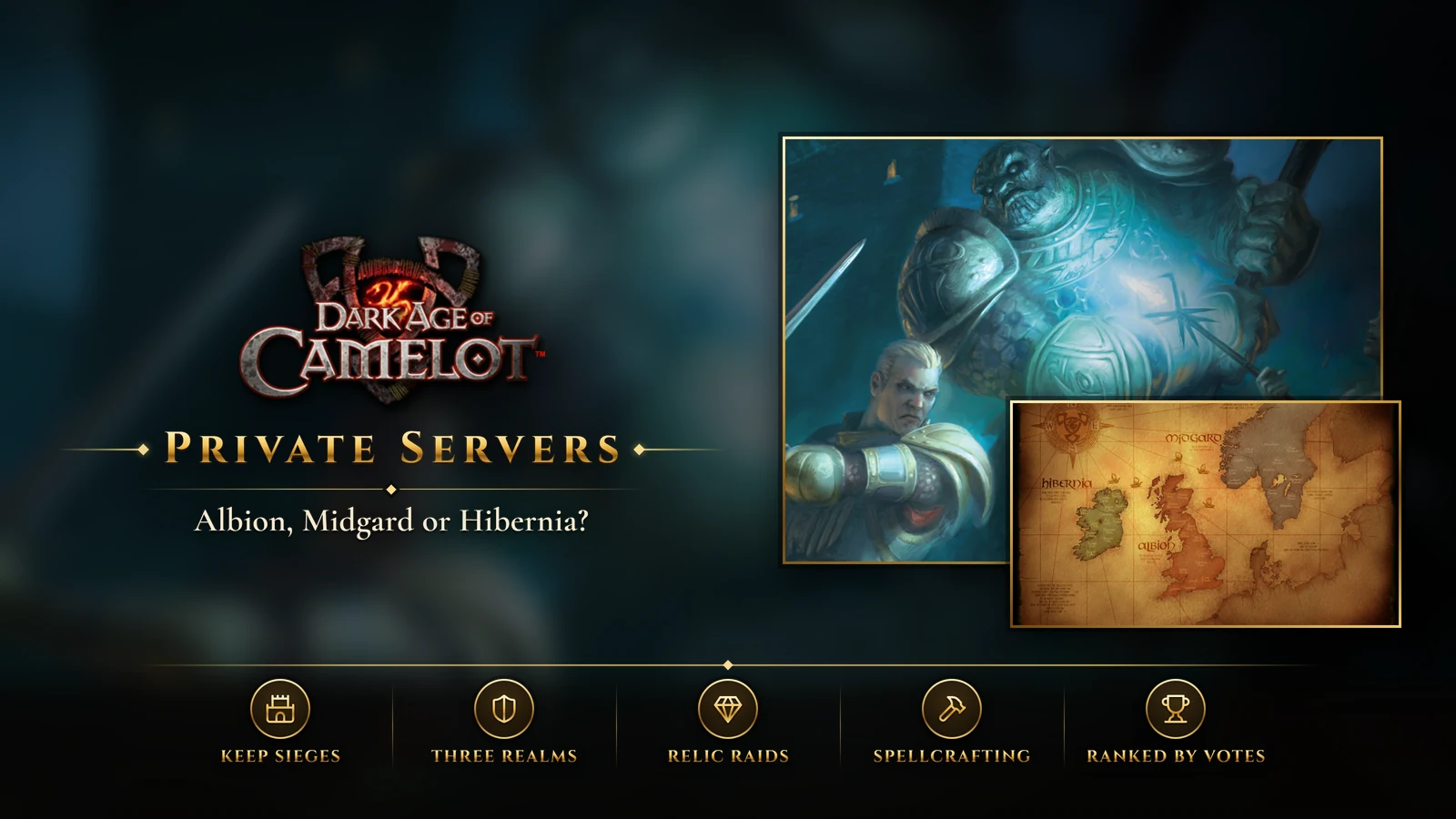
Dark Age of Camelot is Mythic Entertainment's fantasy MMORPG, launched in North America in October 2001 and in Europe in early 2002. Its central idea has rarely been matched since: three realms - Albion, Midgard and Hibernia - locked in permanent war, with large-scale Realm vs Realm combat as the endgame. Development later passed to Broadsword Online Games, and the expansions are now free downloads.
Player-run servers, known in the DAoC community as freeshards, have existed almost as long as the game; fans started an open-source server emulator in 2003. Most freeshards exist to bring back an earlier ruleset - the frontiers and balance from before later revamps and expansions changed the game - with a fresh population fighting over the keeps.
Three Realms at War
Each realm has its own races, classes and mythology: Arthurian Albion, Norse Midgard and Celtic Hibernia. You level through PvE, but the reason to reach the cap of 50 is the frontier. There, the realms fight over keeps and towers and raid each other's strongholds to steal relics that boost the holder's whole realm. Control of the way into Darkness Falls, a dungeon tied to the frontier war, adds another prize. Kills earn realm points, which raise your realm rank and buy realm abilities, so a character keeps growing long after its last level.
Gear has its own depth. Crafters make much of the best equipment, and spellcrafting lets players tune armor stats into a complete template, which is why a good crafter is one of the most valued people in any realm.
What to Look For in a Dark Age of Camelot Private Server
The era and ruleset
This is the first question for any freeshard. Classic servers rebuild the early game, often with the original Old Frontiers zones. Others run the New Frontiers layout introduced in 2004, and some include Trials of Atlantis, the 2003 expansion that added master levels and artifacts on top of normal progression. These are different games in practice, so pick the era you want before you look at anything else.
Realm balance
Three realms only work when all three can field a fight. If one realm is much larger, it holds the keeps and relics and the other two give up. Look at the population of each realm, and check whether the server rewards players who join the smallest side.
Leveling speed and PvE
The official climb to level 50 was long. Many freeshards speed it up so players reach RvR sooner; others keep the classic pace because the PvE trip through each realm is part of the appeal. Check the rates, and whether the server hands out starter gear so new characters can join the frontier without months of farming.
Crafting and gear templates
On a classic server, the gear you fight in is mostly crafted and spellcrafted by players. Some freeshards keep that economy; others simplify it with merchant gear. Neither is wrong, but if you enjoy crafting, a server that removes it removes a large part of what made DAoC special.
Group size and time zone
RvR ranges from solo duels to eight-player groups and huge realm battles. Some servers set rules that favor small, organized groups, while others lean toward big zergs. Weigh that together with the hours your realm is busiest, since peak times differ for European and American players.
Getting Started
Decide on the era first, then the realm - ideally the one that needs players - then a class with a clear role in RvR groups. Join a guild early, because the frontier is a team game and lone players rarely hold a keep. Vote for the server you play on; rankings here start again every month, so the list below shows where players are active now.
Top Dark Age of Camelot Private Servers (2026)
No Dark Age of Camelot private servers are listed yet. Servers added to the site appear here, ranked by this month's player votes.
Frequently Asked Questions
What is the best Dark Age of Camelot private server in 2026?
No Dark Age of Camelot private server is listed here yet. The first ones to be added appear in the ranking on this page, ordered by this month's votes.
How many Dark Age of Camelot private servers are there?
None are listed here yet. A Dark Age of Camelot private server added to the site appears in this ranking as soon as it is active.
How often are these rankings updated?
The ranking is read live from this month's vote counts, so it changes as players vote. Its order last changed on October 13, 2026.
How We Rank Dark Age of Camelot Servers
Servers are listed by the number of counted votes they received this month, most first. Each player can vote for a server once every 24 hours, and every vote is checked for VPNs, proxies and bots before it counts. Vote counts start again from zero on the 1st of every month, and a server that goes 14 days without a counted vote is hidden from the lists until it gets one. Player reviews and ratings are shown on each server's page but do not change its position. How rankings work has the full rules.
- Ordered by this month's counted votes
- One vote per server every 24 hours
- VPN, proxy and bot checks on every vote
- A fresh start on the 1st of every month