
Best Dragon Nest Private Servers 2026 - Level Cap & Nest Guide
Find the best Dragon Nest private servers in 2026. Level caps, nests, rates, ping for action combat and shop policy explained, ranked by real player votes.
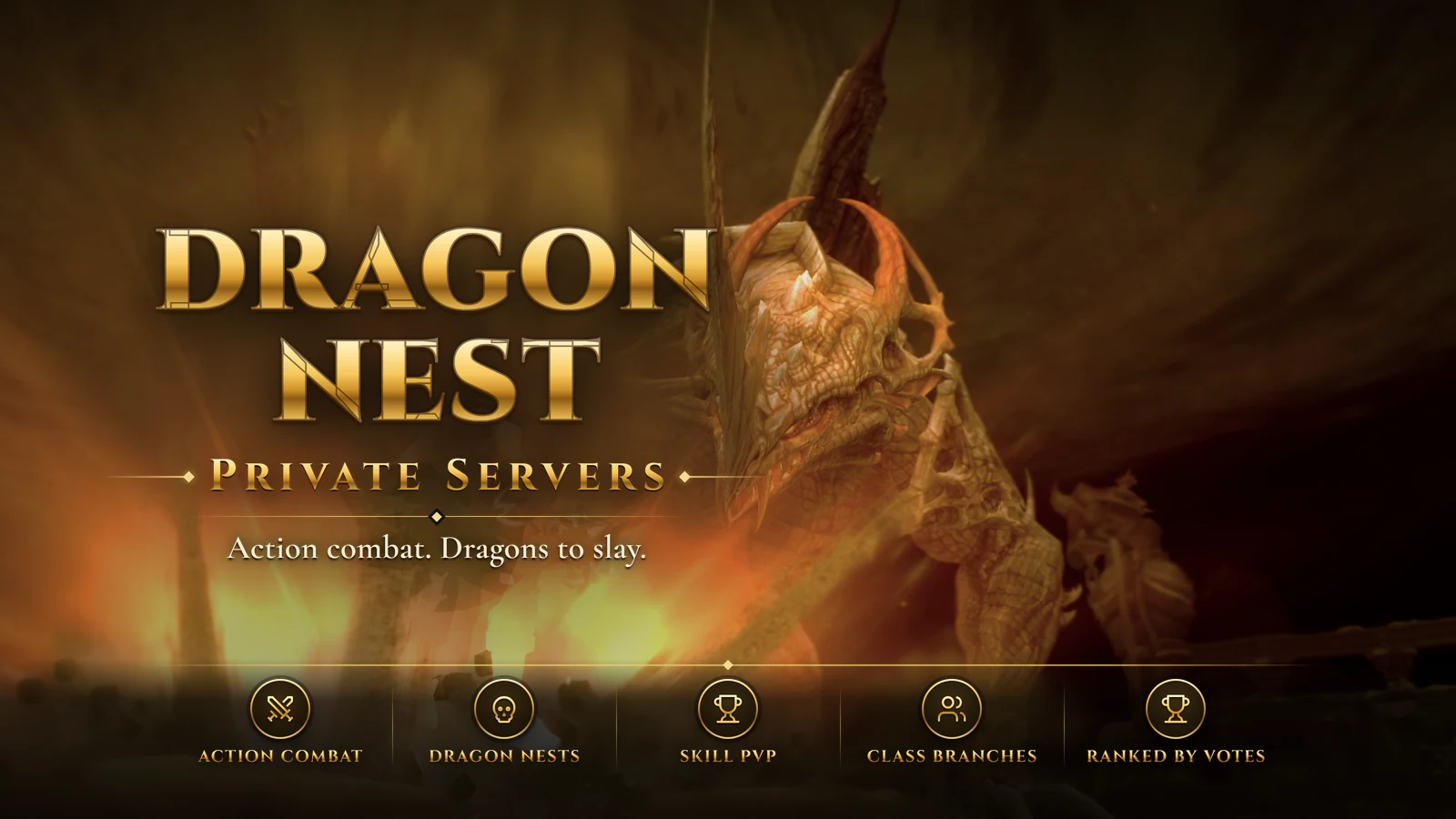
Dragon Nest is Eyedentity Games' action MMORPG, launched in Korea in 2010 and in North America and Southeast Asia in 2011, with Europe following in 2013. It plays more like a brawler than a classic MMO: combat is non-targeting, you aim and dodge every attack yourself, and most of the game happens in instanced dungeons and the big raids called Nests. Some regions have closed - Europe's service shut down in 2019 - while official play continues elsewhere, including a Classic server in Southeast Asia that reopened the game at the original level 32 cap in 2025.
The level cap rose many times over the years, and every raise changed the classes, the gear and which Nests mattered. That is why Dragon Nest private servers exist: players pick the cap they remember, or a modern one with friendlier rates, and play it with a fresh community.
Action Combat, Class Branches and Nests
You start as one of the base classes - Warrior, Archer, Sorceress or Cleric at launch, later joined by the Academic, Kali, Assassin, Lancea and others - and branch into specializations as you level, so a Warrior becomes a Swordsman or a Mercenary and later specializes again. You keep learning skills from each stage, and at higher caps EX skills upgrade them further. Building a skill tree that combos well is half the game.
PvE is built around dungeons and Nests, the multi-stage raids that hold the best rewards, from the Minotaur and Cerberus of the early game to later raids such as the Sea Dragon, Manticore and Apocalypse Nests. PvP uses the same action combat, so timing, positioning and knowing the other class's skills matter as much as your gear.
What to Look For in a Dragon Nest Private Server
The level cap
The cap is the first number on every Dragon Nest server, because it decides everything else. Official caps climbed from 32 to 40, 50, 60, 70 and 80, and later into the 90s. A 32 or 40 cap is the nostalgia bracket, with short skill trees and the first Nests. Mid caps add the later specializations and, from around level 60, EX skills. Caps of 80 and above are the modern game, with more classes and much deeper gear progression.
Which classes exist
Classes arrived over many years; the Lancea, for example, only reached Southeast Asia in 2015. A low-cap server may not have the class you want, and a high-cap one may have rebalanced it beyond recognition. Check the class list and any custom balance changes before you spend a weekend leveling.
Rates, gold and enhancement
Private servers often raise EXP, drop and gold rates, sometimes heavily. That makes leveling quick, but gear enhancement and Nest drops are what keep players around afterwards. A server with sensible enhancement odds and Nest rewards worth farming will hold its community far longer than one that hands out endgame gear on day one.
Ping for action combat
Dodging, skill timing and animation canceling all depend on your connection. A server hosted far from you turns precise combat into guesswork, especially in PvP. Check where the server is hosted and run a dungeon or two before you commit.
Shop and costumes
Read what the shop sells. If the strongest costumes, enhancement protection or gear only come from the store, both Nests and PvP tilt toward whoever spends the most.
Getting Started
Pick the cap you want, confirm your class exists there, and choose a server hosted close to you. Learn your class in regular dungeons, then join a guild that runs Nests on a schedule. Vote for the server you play on; rankings here start again every month, so the list below shows where players are now.
Top 3 Dragon Nest Private Servers (2026)
Ranked by this month's counted votes. Order last changed October 13, 2026.
Vortex Dragon Nest
Fitur Server : 🎯 Max Level 40 🛡️ 7 Classes ⚡ Experience Rate: 300% 💎 Drop Rate: 300% 💰 Gold Rate: 200% 💰 Easy Farming (DNP Farmable) 🔄 Rese...
VorteX Dragon Nest
Join the Hottest Dragon Nest Private Server — VorteX DN! Experience the classic adventure with a modern twist 💥 Server Features: • Max Level 40 ...
Vortex Dragon Nest
VORTEX DRAGONNEST OFFICIAL RELEASE Welcome to VorteX DragonNest, a private server built for players who enjoy exciting progression, challenging conte...
Frequently Asked Questions
What is the best Dragon Nest private server in 2026?
Based on our live vote rankings, Vortex Dragon Nest is currently the #1 ranked Dragon Nest private server with 4 votes this month.
How many Dragon Nest private servers are there?
We currently track 3 active Dragon Nest private servers on our platform, ranked by this month's counted votes.
How often are these rankings updated?
The ranking is read live from this month's vote counts, so it changes as players vote. Its order last changed on October 13, 2026.
How We Rank Dragon Nest Servers
Servers are listed by the number of counted votes they received this month, most first. Each player can vote for a server once every 24 hours, and every vote is checked for VPNs, proxies and bots before it counts. Vote counts start again from zero on the 1st of every month, and a server that goes 14 days without a counted vote is hidden from the lists until it gets one. Player reviews and ratings are shown on each server's page but do not change its position. How rankings work has the full rules.
- Ordered by this month's counted votes
- One vote per server every 24 hours
- VPN, proxy and bot checks on every vote
- A fresh start on the 1st of every month