
Best Elsword Private Servers 2026 - Job Path & PvP Guide
Find the best Elsword private servers in 2026. Versions and job tiers, combo combat, PvP arena modes, raids and shop policy, ranked by real player votes.
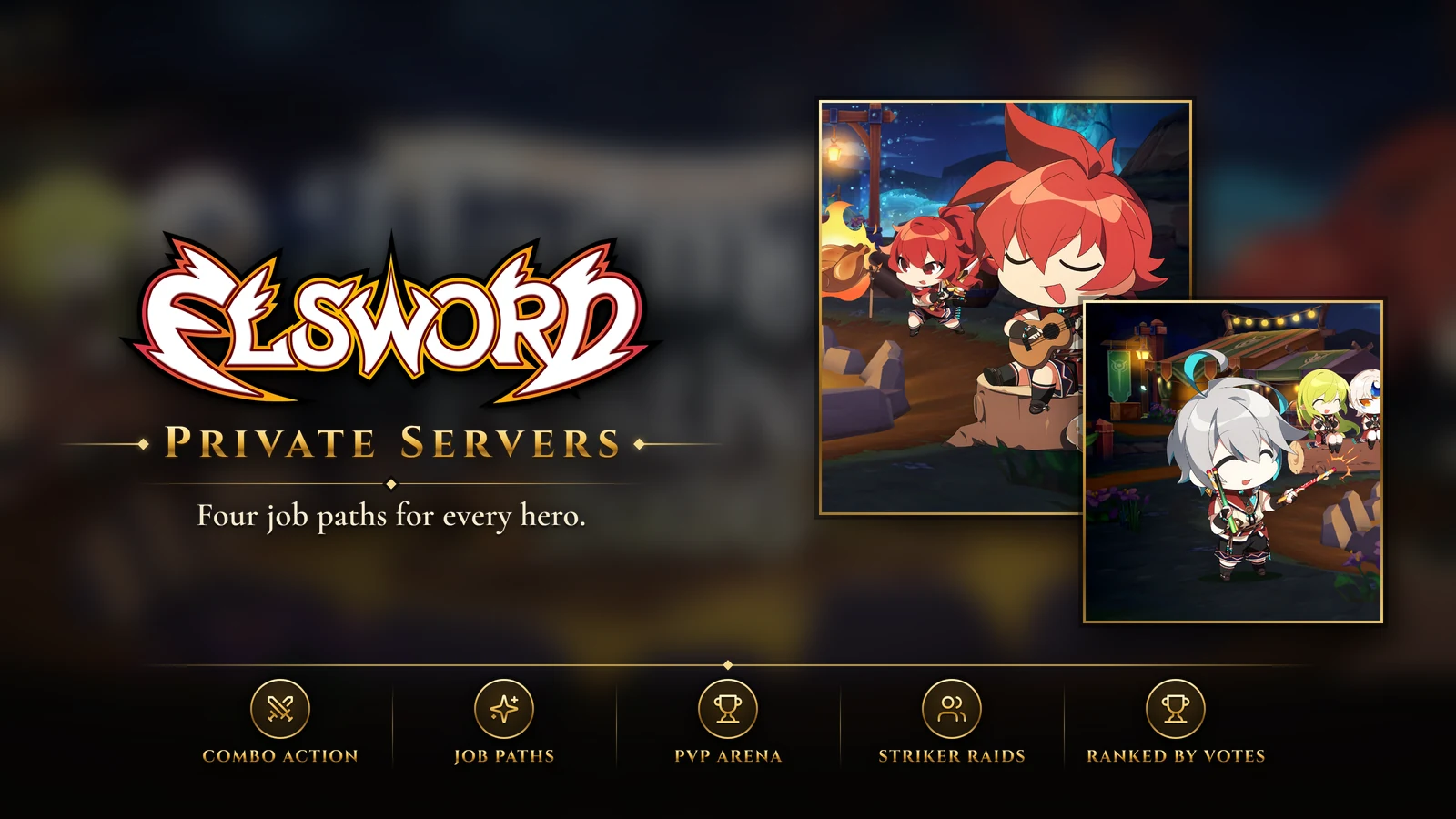
Elsword is a free-to-play 2.5D action MMORPG from the South Korean studio KOG. It launched in Korea in December 2007 and spread to Taiwan, Hong Kong, Japan, China, Thailand and the Philippines, reaching North America in 2011 and Europe, through Gameforge, in 2013. It plays like a side-scrolling beat-'em-up with fighting-game timing, and it began life as a spiritual successor to KOG's earlier Grand Chase before going its own way.
The official game is still being developed, with its job system extended over the years by Transcendence and Master Classes. Fan-run private servers are unofficial and offer something different: an older version from before those later additions, different rates, or a different item economy for players who remember Elsword from an earlier era.
Combos, Job Paths and Raids
Combat is real-time and skill-based, and you can play with keyboard and mouse or a gamepad. Combos are the core, and skills come in several kinds - passive, active, buff and special active skills, with Hyper Actives and Master Skills at the top end. Some characters add mechanics of their own, such as Ara's chain skills or Lu and Ciel's combination skills.
Instead of creating a class, you pick one of the game's named characters - around fifteen by now - and then choose how they grow. Every character has four job paths, starting at level 15. Later steps add Transcendence from level 70, a third job at level 99 and finally a Master Class, unlocked after the last dungeon of the Varnimyr region.
The world is split into eighteen regions, each with a hub town and around six dungeons. Co-op dungeons take up to four players, raids six and striker raids eight. For PvP, the arena offers survival and team modes up to 4v4, with 1v1, 2v2 and 3v3 options depending on the server.
What to Look For in an Elsword Private Server
Version and Job Tiers
The version decides which characters, job paths and regions you can play. Older versions may stop before Transcendence, third jobs or Master Classes, and later characters may be missing. If you have a favorite character or job path, confirm it is in and working before you start.
Input Timing and Ping
Fighting-game timing needs a responsive server. Play a few dungeons and arena matches at your usual hours and check whether combos connect cleanly. If inputs feel late, the game loses most of its appeal.
PvP Balance and Arena Modes
Find out which arena modes are active and populated, and how the server handles balance between characters and job paths. Staff who explain their balance changes make it easier to trust a ranked ladder.
Gear and Shop Policy
Look at how gear is enhanced and what the shop sells. Costumes are easy to accept; selling stats, enhancement items or top gear decides arena matches before they start. Prefer servers where power comes from play.
Raids and Population
Six- and eight-player raids need an active community. Check the server's busy hours, its main language and whether raid groups form regularly.
Classic or Modern Elsword
Classic-leaning servers recreate the game before its later job tiers, with a smaller roster and a shorter road to the top. Modern-leaning servers include more characters, Transcendence and Master Classes, and far more endgame to chase. Neither is better by default: pick the era you want to play, then judge each server on how well it runs that era.
Your First Job Change
Pick a character whose style you enjoy and look ahead at their four job paths before your first job change at level 15. Spend time learning combos in early dungeons, then try the arena. Vote for the server you play on; rankings here start again every month, so the list below follows where players are now.
Top Elsword Private Servers (2026)
No Elsword private servers are listed yet. Servers added to the site appear here, ranked by this month's player votes.
Frequently Asked Questions
What is the best Elsword private server in 2026?
No Elsword private server is listed here yet. The first ones to be added appear in the ranking on this page, ordered by this month's votes.
How many Elsword private servers are there?
None are listed here yet. A Elsword private server added to the site appears in this ranking as soon as it is active.
How often are these rankings updated?
The ranking is read live from this month's vote counts, so it changes as players vote. Its order last changed on October 13, 2026.
How We Rank Elsword Servers
Servers are listed by the number of counted votes they received this month, most first. Each player can vote for a server once every 24 hours, and every vote is checked for VPNs, proxies and bots before it counts. Vote counts start again from zero on the 1st of every month, and a server that goes 14 days without a counted vote is hidden from the lists until it gets one. Player reviews and ratings are shown on each server's page but do not change its position. How rankings work has the full rules.
- Ordered by this month's counted votes
- One vote per server every 24 hours
- VPN, proxy and bot checks on every vote
- A fresh start on the 1st of every month