
Best Empyrion Servers 2026 - PvE, PvP & Scenario Server Guide
Find the best Empyrion servers in 2026. PvE vs PvP planets, scenario mods, structure limits, factions, wipes and admins explained, ranked by real player votes.
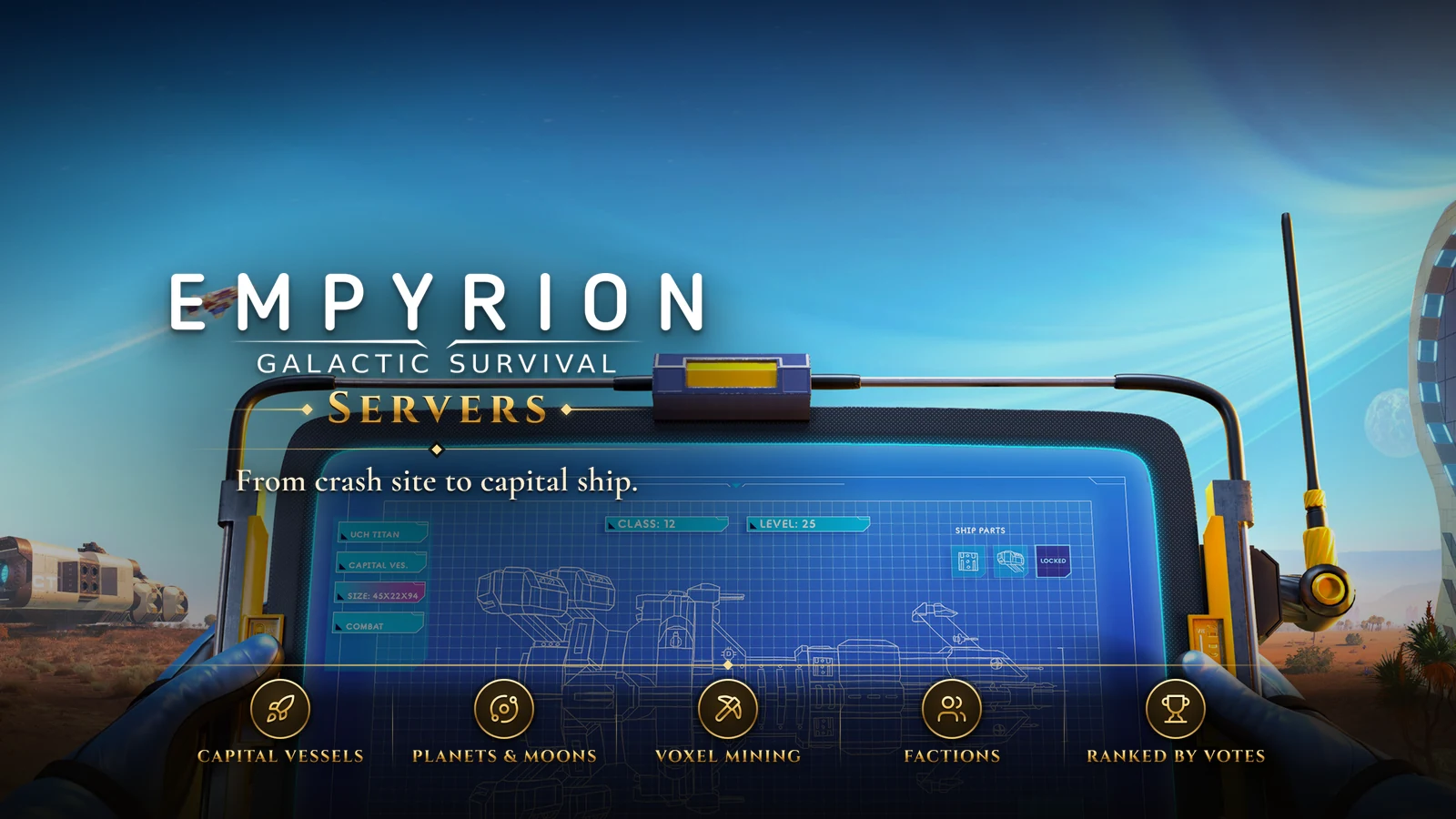
Empyrion - Galactic Survival is Eleon Game Studios' space survival sandbox for PC, fully released in August 2020 after a long early access period. You travel between planets, moons and star systems, each with its own gravity, atmosphere, climate and wildlife, and you build everything you need block by block: planetary settlements, space stations, agile fighters and huge capital vessels. The terrain is voxel-based, so you can dig, flatten and tunnel anywhere.
Empyrion can be played alone or in co-op, but its multiplayer servers are where factions form, territory is claimed and wars are fought between the stars. Server owners decide which planets allow PvP, which scenario the galaxy runs and how large your ships can grow, so the server shapes the whole game.
From Crash Site to Capital Ship
A typical start leaves you on a planet with little more than a survival kit. Food and oxygen come first, hostile creatures and alien forces second. From there you dig for ore, build a base and a hover vessel, craft your way up a tech tree, and eventually build a small vessel that reaches orbit. Asteroid fields and alien structures hold the resources and loot you need for the big step: a capital vessel that can take you to other star systems.
Building is the heart of it. Ships and bases are designed piece by piece, and the Steam Workshop is full of community blueprints for players who would rather fly than design. In multiplayer, factions pool their resources to build fleets and stations, form alliances and fight for control of a solar system.
What to Look For in an Empyrion Server
Default Game or Scenario
Many servers run community scenarios, such as the well-known Reforged Eden, which rework the galaxy, the blocks, the enemies and the progression. A scenario server can feel like a different game from the default one, so check which version a server runs and what it changes before you start building.
PvE Areas and PvP Planets
Empyrion mixes protected PvE areas with PvP planets and systems. A server's map decides where you are safe, where you can be attacked and where the best resources sit. If you plan to build in a PvP zone, check whether the server protects structures while their owners are offline.
Structure Limits and Performance
Servers cap ship sizes, structure counts or similar limits to keep the game running. Find out what you are allowed to build before you design a capital vessel, and whether abandoned structures are cleaned up. A server that stays smooth with many players and ships online is worth more than one with no limits.
Factions and Economy
Factions are how most players experience a server, so look at how they are organized: size limits, alliances, trading between players and any server-run markets or rewards. A healthy server has several active factions rather than one that owns everything.
Galaxy Resets, Admins and Population
Major game updates and new scenario versions often mean a fresh galaxy, so ask how the server handles them and how much warning it gives. Look for admins who answer on Discord and help with lost ships, and check that the server is busy at your hours.
Getting Started
Decide between the default game and a scenario, and between PvE and PvP play. Join the server's Discord, read the rules on building limits and protected zones, and keep your first ship small until you know the server. The ranking below lists the Empyrion servers players vote for here. Vote for the server you fly on - rankings reset every month, so the list reflects where players are active now.
Top Empyrion Servers (2026)
No Empyrion servers are listed yet. Servers added to the site appear here, ranked by this month's player votes.
Frequently Asked Questions
What is the best Empyrion server in 2026?
No Empyrion server is listed here yet. The first ones to be added appear in the ranking on this page, ordered by this month's votes.
How many Empyrion servers are there?
None are listed here yet. A Empyrion server added to the site appears in this ranking as soon as it is active.
How often are these rankings updated?
The ranking is read live from this month's vote counts, so it changes as players vote. Its order last changed on October 13, 2026.
How We Rank Empyrion Servers
Servers are listed by the number of counted votes they received this month, most first. Each player can vote for a server once every 24 hours, and every vote is checked for VPNs, proxies and bots before it counts. Vote counts start again from zero on the 1st of every month, and a server that goes 14 days without a counted vote is hidden from the lists until it gets one. Player reviews and ratings are shown on each server's page but do not change its position. How rankings work has the full rules.
- Ordered by this month's counted votes
- One vote per server every 24 hours
- VPN, proxy and bot checks on every vote
- A fresh start on the 1st of every month