
Best Grand Fantasia Private Servers 2026 - Sprites & Class Guide
Find the best Grand Fantasia private servers in 2026. Level caps, class paths, sprite crafting, rates and item mall policy, ranked by real player votes.
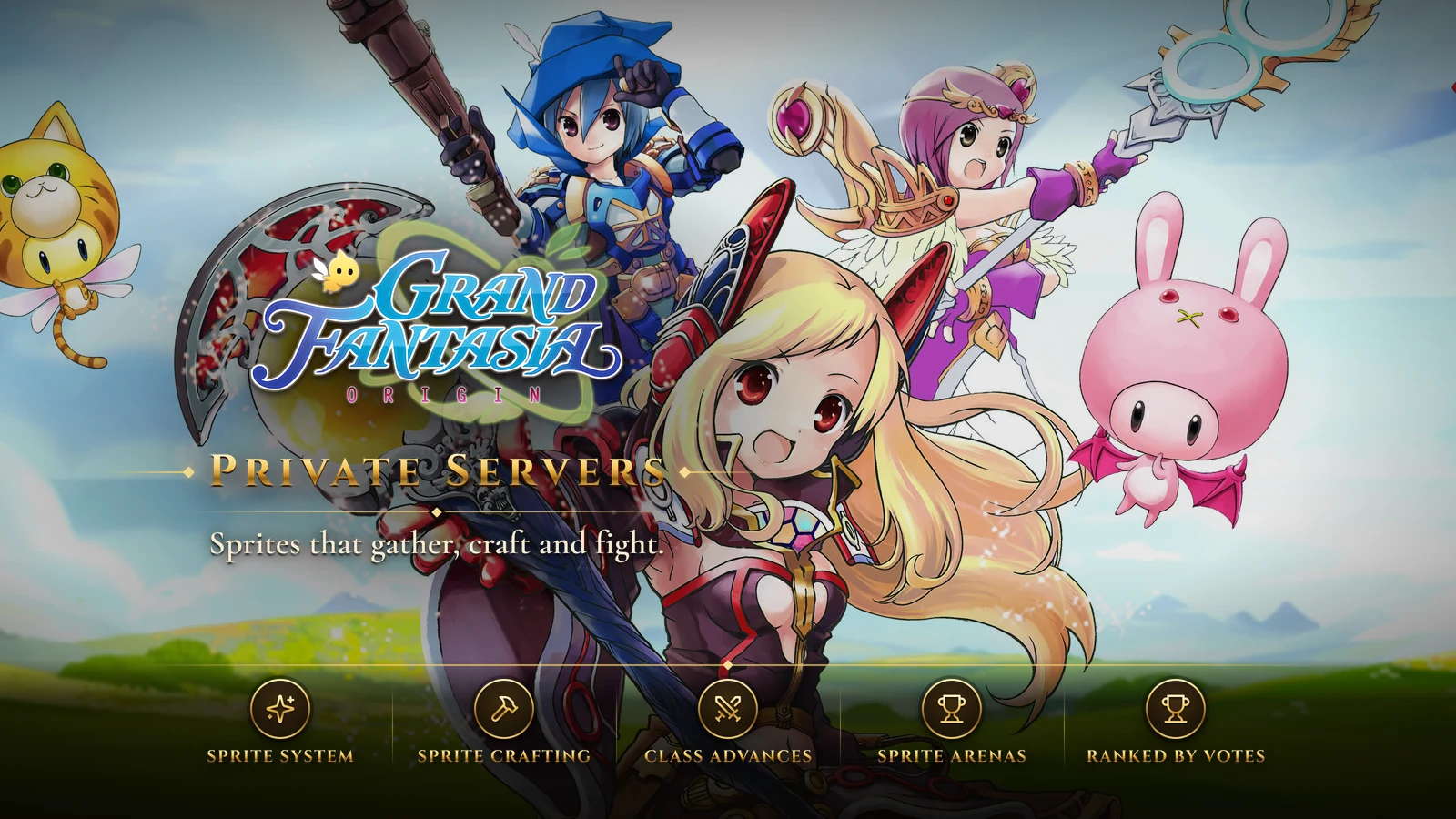
Grand Fantasia is an anime-style MMORPG from Taiwanese studio X-Legend Entertainment, launched in North America and Europe through Aeria Games on December 1, 2009. It is best remembered for its sprites - small companions that gather materials, craft gear and support you in combat - and for a bright world built for long questing sessions. When gamigo closed the Aeria Games portal, X-Legend took over the game itself in February 2023, and in 2024 it announced Grand Fantasia: Origin, an enhanced version on an upgraded engine.
Players come to Grand Fantasia private servers for the usual reasons: an earlier version of the game, faster rates, a lighter item mall, or a smaller community where everyone starts together. This guide covers what makes the game distinctive and what to check before you choose a server.
Sprites and Class Paths
Every character starts on Siwa Island as one of four classes - Fighter, Hunter, Acolyte or Spellcaster - and has to choose before leaving. At level 15 you travel to your class's home city to advance, and further specializations follow at later levels, so each starting class branches into several different builds. Much of the planning in Grand Fantasia is about which branch you take at each step.
The sprite system is what people remember most. Sprites follow you, raise your stats in battle and, more importantly, work for you: send them out to gather and they come back with raw materials, give them recipes and they craft weapons and armor. You can keep up to three, so a large part of the economy runs through what players' sprites produce. Sprites even get their own arenas, next to the regular duels and PvP arenas.
What to Look For in a Grand Fantasia Private Server
Version and Level Cap
Grand Fantasia gained classes, levels, dungeons and systems over more than a decade of updates. A private server picks one version, from early caps with the original class set to later clients with the full roster. Check the level cap and which classes and specializations exist before you plan a character.
Sprite Crafting and Gathering
Because sprites drive the economy, look closely at how the server handles them: how long gathering takes, which recipes are available, and whether sprite-related items are earned in game or sold. A server that sells the best crafting results directly has hollowed out one of the game's best systems.
Rates and Leveling Pace
Questing is the heart of Grand Fantasia, so very high EXP rates skip much of what makes the world charming. Moderate rates let you see the zones while trimming the grind. Check drop and crafting rates too, since they decide how fast gear loses its value.
Item Mall Policy
The official game sold costumes, convenience items and boosts. On a private server, look at whether the shop sticks to cosmetics or sells upgrades that decide PvP. Premium currency you can earn through play or voting is a good sign.
Population and Language
Dungeons, arenas and guild play need people online together. Check where the community is based, which language it uses and how busy the server is at your hours.
Classic or Custom
Some servers aim to recreate the Grand Fantasia players knew in its early Aeria years, with the original zones and pacing. Others build on later versions and add custom dungeons, items or events. A classic server is the better pick for nostalgia; a custom one suits players who have already seen everything the original offered.
Getting Started
Choose the version and cap that match what you want, then pick a starting class on Siwa Island with your long-term branch in mind. Get your first sprite working early, because gathering in the background speeds up everything else. When a server earns your time, vote for it. The ranking below lists the Grand Fantasia servers players vote for here, and it starts again every month.
Top Grand Fantasia Private Servers (2026)
No Grand Fantasia private servers are listed yet. Servers added to the site appear here, ranked by this month's player votes.
Frequently Asked Questions
What is the best Grand Fantasia private server in 2026?
No Grand Fantasia private server is listed here yet. The first ones to be added appear in the ranking on this page, ordered by this month's votes.
How many Grand Fantasia private servers are there?
None are listed here yet. A Grand Fantasia private server added to the site appears in this ranking as soon as it is active.
How often are these rankings updated?
The ranking is read live from this month's vote counts, so it changes as players vote. Its order last changed on October 13, 2026.
How We Rank Grand Fantasia Servers
Servers are listed by the number of counted votes they received this month, most first. Each player can vote for a server once every 24 hours, and every vote is checked for VPNs, proxies and bots before it counts. Vote counts start again from zero on the 1st of every month, and a server that goes 14 days without a counted vote is hidden from the lists until it gets one. Player reviews and ratings are shown on each server's page but do not change its position. How rankings work has the full rules.
- Ordered by this month's counted votes
- One vote per server every 24 hours
- VPN, proxy and bot checks on every vote
- A fresh start on the 1st of every month