
Best Guild Wars Private Servers 2026 - Campaign & Build Guide
Find the best Guild Wars private servers in 2026. Campaign support, skill balance, PvP formats and account safety explained, ranked by real player votes.
Guild Wars is ArenaNet's 2005 fantasy online RPG, published by NCSoft, and it broke the MMO mold of its time: buy the game once and play without a subscription. It is built around instanced missions and explorable areas, a low level cap of 20, and a skill system where what you bring matters more than how long you have played. The official game is still supported - a remastered edition, Guild Wars Reforged, launched in December 2025.
Fan-run Guild Wars servers are a small niche, and the projects that exist tend to be small too. Players who look for them usually want something a live game with one current version cannot offer: a particular era, such as the original Prophecies campaign on its own, or the skill balance of a specific period in the game's competitive history.
Eight Skills, Two Professions
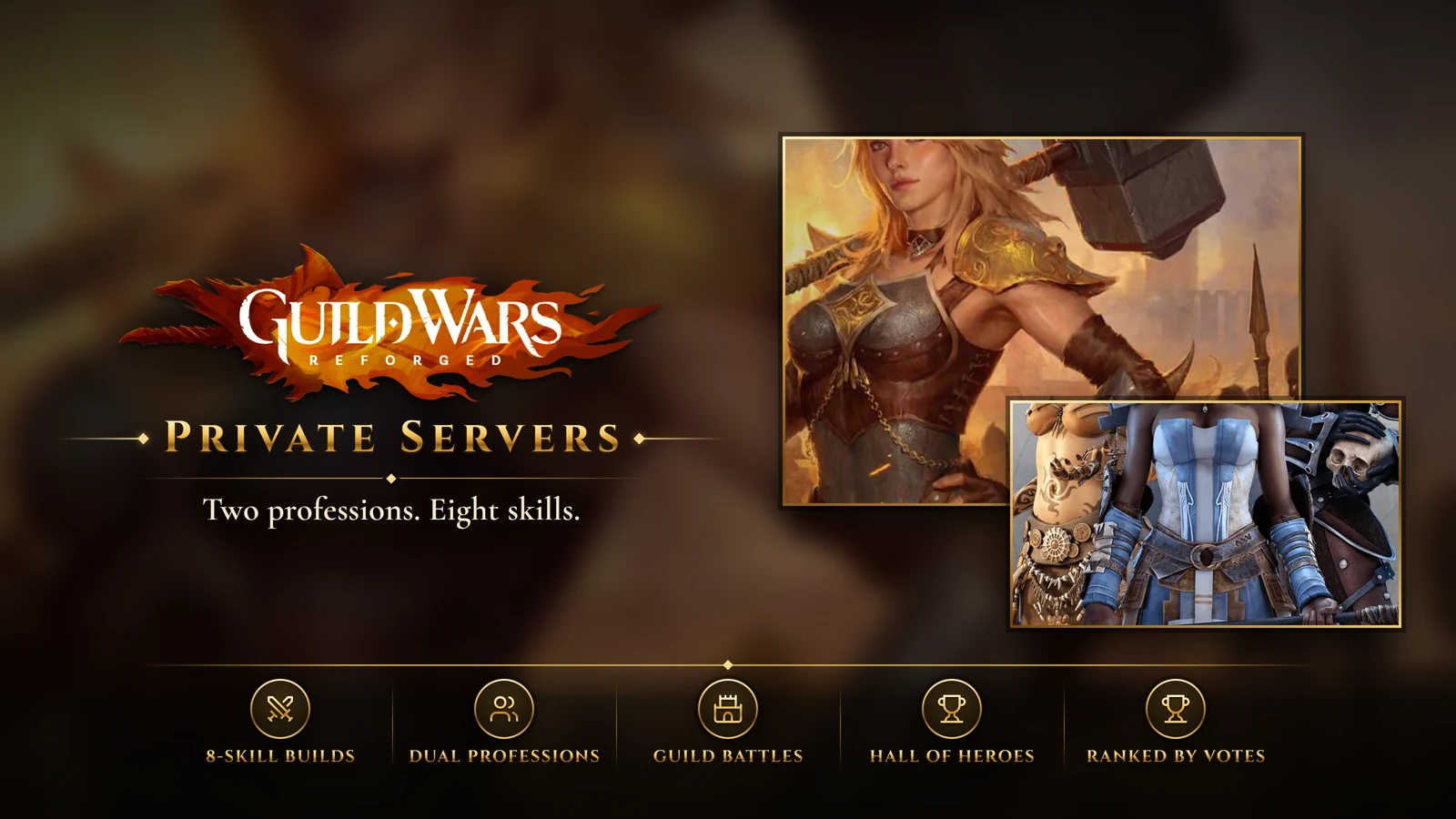
Every character picks a primary and a secondary profession, and from more than a thousand skills you can equip only eight at a time. Your build is locked once you leave town, so preparation is the game: reading the next mission, choosing the right eight and fitting them around your party's builds. With a level cap of 20, a new character reaches the real game quickly, and power comes from the skills you unlock and the builds you learn rather than from endless grinding.
The world grew through the Prophecies campaign, the Factions and Nightfall campaigns and the Eye of the North expansion. PvP was central from the start, with guild battles, Heroes' Ascent ending in the Hall of Heroes, and the Alliance Battles that arrived with Factions.
What to Look For in a Guild Wars Private Server
Which campaigns actually work
Recreating Guild Wars means rebuilding a huge amount of instanced content: missions, explorable areas, quests and monster behavior. Check exactly which campaigns, towns and missions a server supports and how complete they are. A server that runs one campaign well is a better home than one that lists four and runs half of each.
Skill balance version
ArenaNet rebalanced skills many times over the years, and every balance produced its own builds. A fan server may recreate a specific historical balance or make its own changes. If you care about a particular PvE build or PvP meta, check which balance the server uses before you build around it.
PvP formats and population
Guild battles, Heroes' Ascent and Alliance Battles need enough players and working matchmaking. Ask which formats actually run, and whether there are enough players to fill them at your hours. A PvP format with nobody queuing is only a menu entry.
Account safety
Fan servers use their own accounts. Never reuse the email and password from your official Guild Wars account, and download clients only from the project's own pages. A trustworthy team explains clearly what you are installing and why.
Development pace and openness
Emulating a game like this is long, slow work. Look at how often the project posts updates and fixes, and whether its developers say openly what works and what does not. Honest patch notes are the best sign that a project will still exist next year.
Getting Started
Treat any Guild Wars fan server as a project in progress. Read its feature list carefully, create a fresh account with new credentials, and start with a profession pair you know well so you can judge how faithful the server is. Vote for the server you play on; rankings here start again every month, so the list below shows which servers players are active on now.
Top Guild Wars Private Servers (2026)
No Guild Wars private servers are listed yet. Servers added to the site appear here, ranked by this month's player votes.
Frequently Asked Questions
What is the best Guild Wars private server in 2026?
No Guild Wars private server is listed here yet. The first ones to be added appear in the ranking on this page, ordered by this month's votes.
How many Guild Wars private servers are there?
None are listed here yet. A Guild Wars private server added to the site appears in this ranking as soon as it is active.
How often are these rankings updated?
The ranking is read live from this month's vote counts, so it changes as players vote. Its order last changed on October 13, 2026.
How We Rank Guild Wars Servers
Servers are listed by the number of counted votes they received this month, most first. Each player can vote for a server once every 24 hours, and every vote is checked for VPNs, proxies and bots before it counts. Vote counts start again from zero on the 1st of every month, and a server that goes 14 days without a counted vote is hidden from the lists until it gets one. Player reviews and ratings are shown on each server's page but do not change its position. How rankings work has the full rules.
- Ordered by this month's counted votes
- One vote per server every 24 hours
- VPN, proxy and bot checks on every vote
- A fresh start on the 1st of every month