
Best Luna Online Private Servers 2026 - Class Tree & Family Guide
Find the best Luna Online private servers in 2026. Classic vs Luna Plus, the 52-class tree, families and farms, shop policy, ranked by real player votes.
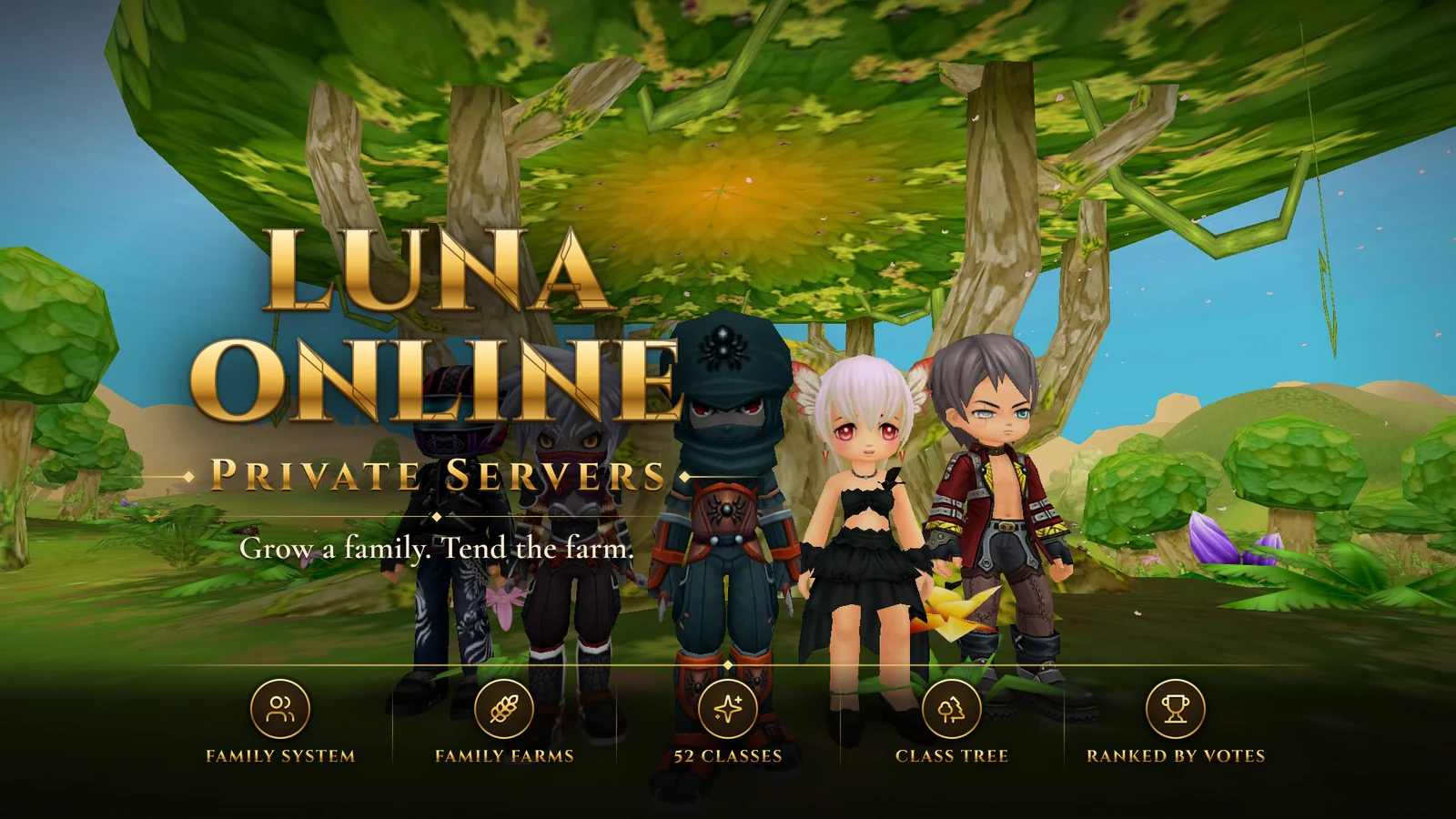
Luna Online is a cheerful anime-style MMORPG from the Korean studio EYA Interactive, launched in Korea in 2007 and later run in Thailand, Taiwan and Hong Kong, with gPotato publishing it in North America from 2009. It became known for its bright, cute look, a huge branching class tree and social systems built around small groups of friends. The Luna Plus expansion followed in 2011, the North American servers closed in 2012, and a crowdfunded relaunch arrived on Steam in 2016 as Luna Online: Reborn.
All those changes of publisher and version left players attached to different eras of Luna. Fan-run private servers let them return to the one they remember, usually with friendlier rates and a lighter shop.
A Branching Class Tree and Family Farms
Each character starts on a base class line and advances through several stages, choosing a branch at each one; by fan count the full tree holds 52 classes. Your advancement path is one of the biggest decisions in the game, and with up to five characters per account, many players try more than one line before settling on a favorite.
Luna's social side is what sets it apart. Players form families of up to five members, and a family can buy and run a farm that levels up over time and provides further benefits. It turns a small circle of friends into a shared long-term project, and it gives the game a slower, homier rhythm alongside the usual leveling, quests and dungeon runs.
What to Look For in a Luna Online Private Server
Classic or Luna Plus
Servers built on the original game have the classic areas and level range. Those built on Luna Plus include the extra areas, levels and cosmetic items the 2011 expansion added. Check which version and level cap a server uses, and whether it has added content of its own on top.
A complete class tree
With 52 classes, it is easy for a server to have broken skills or branches that do not work at the top end. Check that your intended class line works all the way up, and look at how quickly the staff fix skill bugs when players report them.
Families and farms
Families and farms are a large part of Luna's charm. Make sure both are enabled and working, and that farm upgrades can be reached through play rather than only through the shop.
Costumes, boosts and the shop
Luna's cute style makes costumes a natural thing to sell, and cosmetic items were part of what Luna Plus added. Costumes are harmless; stat items, upgrade materials and experience boosts that cannot be earned in play are not. Read the shop list before you invest weeks in a character.
Who is online, and in what language
Luna had official communities in several regions, and private servers often lean toward one language. Check the main language in chat and on the community channel, and whether players are online at your hours, because families and farms only work with people to share them.
Relaxed or Fast-Paced
Luna private servers tend to lean one of two ways. Relaxed servers keep rates near the original, so climbing the class tree and building up a farm take weeks, and the social side of the game has time to grow. Fast servers boost rates heavily and get players to the top classes quickly, then rely on events and custom content to keep them around. Pick the one that matches how much time you have.
Getting Started
Choose classic or Luna Plus, then look through the class tree and pick the branch you are aiming for before you advance. Find or start a family early, since the farm rewards a group that plays together over weeks. Vote for the server you play on; rankings here start again every month, so the list below shows where players are now.
Top Luna Online Private Servers (2026)
No Luna Online private servers are listed yet. Servers added to the site appear here, ranked by this month's player votes.
Frequently Asked Questions
What is the best Luna Online private server in 2026?
No Luna Online private server is listed here yet. The first ones to be added appear in the ranking on this page, ordered by this month's votes.
How many Luna Online private servers are there?
None are listed here yet. A Luna Online private server added to the site appears in this ranking as soon as it is active.
How often are these rankings updated?
The ranking is read live from this month's vote counts, so it changes as players vote. Its order last changed on October 13, 2026.
How We Rank Luna Online Servers
Servers are listed by the number of counted votes they received this month, most first. Each player can vote for a server once every 24 hours, and every vote is checked for VPNs, proxies and bots before it counts. Vote counts start again from zero on the 1st of every month, and a server that goes 14 days without a counted vote is hidden from the lists until it gets one. Player reviews and ratings are shown on each server's page but do not change its position. How rankings work has the full rules.
- Ordered by this month's counted votes
- One vote per server every 24 hours
- VPN, proxy and bot checks on every vote
- A fresh start on the 1st of every month