
Best MU Legend Private Servers 2026 - Classes & Revival Guide
Find the best MU Legend private servers in 2026. Six classes, client versions, loot and drop rates, dungeons and shop policy, ranked by real player votes.
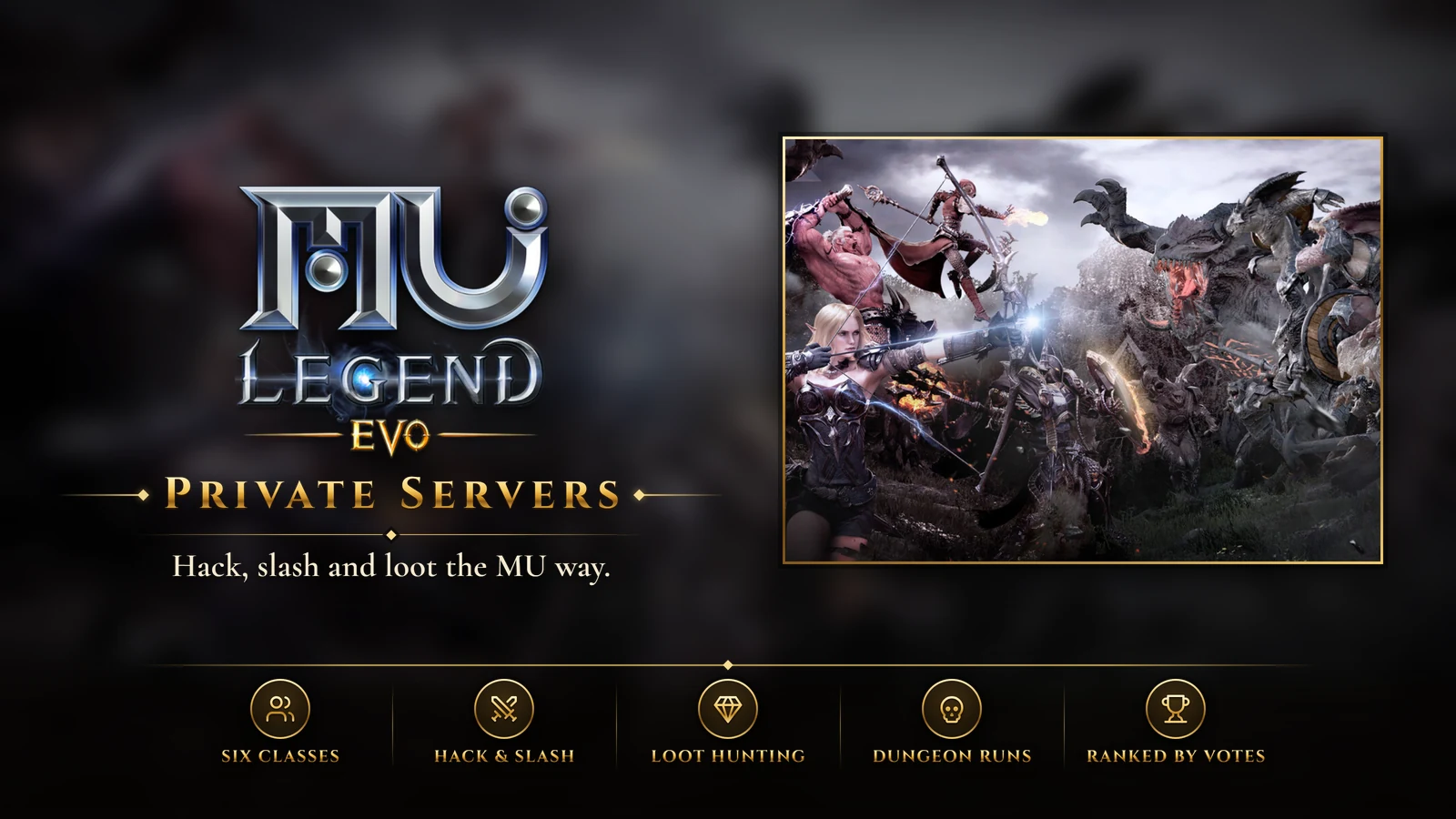
MU Legend is Webzen's action-RPG successor to Mu Online. It soft-launched in late 2017 with Korea first and a global version following, and it traded the original's slow isometric grind for fast hack-and-slash combat while keeping the MU name and world. About two years after launch, Webzen handed the global version to VALOFE Global. In 2023 the game was taken offline so it could be rebuilt from its base, with a promise to return, and by mid-2024 more than a year had passed without a status update.
With the official service taken down, players who miss MU Legend have few places to go, and fan-run servers for it are rare. Most of the MU private-server scene is built around the original Mu Online, which has its own ranking. This guide covers what MU Legend offered and what to check if you come across a server for it.
Mu, Rebuilt as an Action RPG
MU Legend launched with four classes - the Blader, Dark Lord, War Mage and Whisperer - and later added the Black Phantom and the Spellbinder. Combat is fast and skill-driven: you clear packs of monsters in seconds, chase better item drops and work through dungeons alone or in a party, closer to a loot-focused action RPG than a traditional MMO. The MU heritage shows in the setting, the familiar class archetypes and the heavy focus on gear.
That focus makes MU Legend a different kind of game from its predecessor. Where Mu Online is about resets, jewels and long-term leveling, MU Legend is about runs: enter a dungeon, clear it quickly, see what dropped, and do it again with a stronger build.
What to Look For in a MU Legend Private Server
Client Version and Class List
MU Legend changed over its official life, adding classes, dungeons and systems. A fan server is built on one client, so check which classes are playable - all six or only the launch four - and how far the content goes before you plan a build.
Loot and Drop Rates
In a loot-driven game, drop rates are the economy. Generous rates make the early game fly by, but if top gear drops constantly there is nothing left to chase. Look for rates that speed things up without removing the hunt for better items.
Stability and Completeness
Running a game this complex outside its official service is hard. Test dungeons, skills and item systems before investing heavily, and see whether the team fixes reported problems quickly.
Solo and Party Balance
MU Legend's dungeons can be run alone or in groups. Check whether the server has tuned difficulty and rewards for the population it actually has. On a small server, dungeons that assume a full party are frustrating, while content that is trivial solo gets boring fast. A team that adjusts this over time understands the game.
Shop Policy
See what the shop sells. In a gear-focused game, selling equipment or upgrade materials undercuts the main reason to play, while cosmetics and convenience items do not.
Community and Time Zone
Party dungeons need people online together. Check the community's size, language and peak hours before you commit to a character.
Getting Started
Confirm which client and classes the server offers, then level a character through the early dungeons to judge combat and stability. Keep expectations realistic for a small scene; if you want a larger community in the same world, Mu Online's servers are the bigger alternative. If a MU Legend server earns your time, vote for it. The ranking below lists the MU Legend servers players vote for here, and it starts again every month.
Top MU Legend Private Servers (2026)
No MU Legend private servers are listed yet. Servers added to the site appear here, ranked by this month's player votes.
Frequently Asked Questions
What is the best MU Legend private server in 2026?
No MU Legend private server is listed here yet. The first ones to be added appear in the ranking on this page, ordered by this month's votes.
How many MU Legend private servers are there?
None are listed here yet. A MU Legend private server added to the site appears in this ranking as soon as it is active.
How often are these rankings updated?
The ranking is read live from this month's vote counts, so it changes as players vote. Its order last changed on October 13, 2026.
How We Rank MU Legend Servers
Servers are listed by the number of counted votes they received this month, most first. Each player can vote for a server once every 24 hours, and every vote is checked for VPNs, proxies and bots before it counts. Vote counts start again from zero on the 1st of every month, and a server that goes 14 days without a counted vote is hidden from the lists until it gets one. Player reviews and ratings are shown on each server's page but do not change its position. How rankings work has the full rules.
- Ordered by this month's counted votes
- One vote per server every 24 hours
- VPN, proxy and bot checks on every vote
- A fresh start on the 1st of every month