
Best Rust Servers 2026 - Wipe Days, Group Limits & Rates Guide
Find the best Rust servers in 2026. Vanilla vs modded, wipe schedules, group limits, gather rates and admin quality explained, ranked by real player votes.
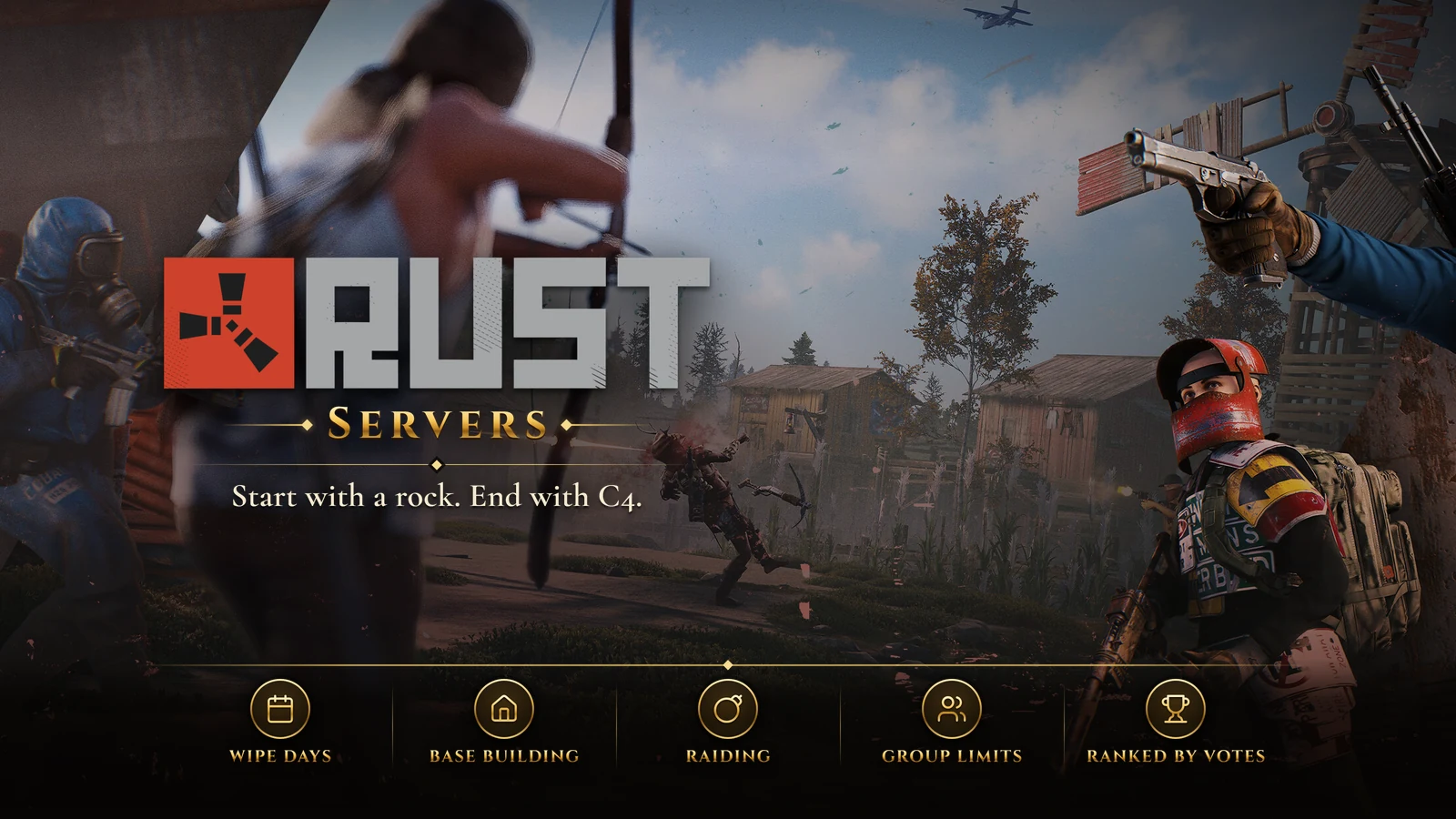
Rust is Facepunch Studios' multiplayer survival game, in early access from December 2013 and fully released in February 2018, with a separate console edition since 2021. You spawn on a beach with a rock and a torch, gather wood and stone, craft tools and weapons, and build a base that every other player on the server is free to raid. Nothing about it is safe, and nothing about it is permanent.
Every month Facepunch ships a mandatory update on the first Thursday, and that update forces every server onto a fresh map. Inside that rhythm, community and modded servers set their own rules: how often they wipe, how big a group can be, how fast resources come in. Those choices change the game more than any patch.
Build, Raid, Wipe, Repeat
A wipe starts with a race. Players gather, research blueprints at workbenches and climb the tech tree from stone spears to rifles. Your base is protected by a Tool Cupboard, which stops others from building near it, and by layers of doors and walls that make raiding expensive. Raids use explosives such as C4 and rockets, so every base is really a question of how much it costs someone to break in.
Between raids sit the monuments, from small roadside sites to heavily guarded places like Launch Site, Oil Rig and Cargo Ship, where AI scientists guard the best loot and players fight over it. By the end of a wipe the big groups are armed and the map is full of bases. Then the server wipes, and it all starts again.
What to Look For in a Rust Server
Official, Community or Modded
The server browser splits servers into three tabs. Official servers are run by Facepunch. Community servers are hosted by others but keep vanilla gameplay. Modded servers change the game itself: 2x, 5x or 10x gather rates, kits, teleports, skill trees, custom events and much more. A 2x server keeps most of the vanilla feel while saving hours of farming; a 10x server is close to a different game.
Wipe Schedule
Every server's map resets on the monthly forced wipe, but many also wipe weekly or every two weeks, and blueprint wipes follow the server's own policy. Short cycles suit players who can only commit a few days at a time; monthly servers reward long-term planning. Check the wipe day and time in your time zone, because wipe day is when the population peaks.
Group Limits
This decides who you are fighting. Solo, duo, trio and quad servers cap team size, while no-limit servers let large clans take over the map. A limit only matters if admins enforce it, so look for clear rules on alliances and on how violations are checked.
Admins and Cheating
Rust uses EasyAntiCheat, but community servers still need staff who respond to reports, review suspicious players and ban quickly. A good server has a working report system and a Discord where admins actually answer. Be wary of servers where staff play on the same map with admin powers and no clear rules for themselves.
Population and Map Size
A big map with a small population feels empty, and a small map with a full server turns into constant fighting. Look at the player count a few days after wipe, not only on wipe day, since many servers lose most of their players within the first week. Pick a server hosted near you, because Rust gunfights punish high ping.
Common Rust Server Styles
- Vanilla monthly - the game as Facepunch designed it, one map for a full month.
- Vanilla+ - vanilla rates with small quality-of-life plugins.
- Boosted rates - 2x to 10x gathering, often with kits and shorter wipes.
- Battlefield and arena - instant gear and constant PvP, with building mostly out of the picture.
- PvE - raiding and player killing switched off, with the AI, monuments and building as the game.
Getting Started
Choose your group size first, then the wipe cycle, then the rates. Join on or just after wipe day so you start level with everyone else, and read the server's rules on groups and raiding before you build. The ranking below lists the Rust servers players vote for here. Vote for the server you play on - rankings start again every month, just like the maps.
Top Rust Servers (2026)
No Rust servers are listed yet. Servers added to the site appear here, ranked by this month's player votes.
Frequently Asked Questions
What is the best Rust server in 2026?
No Rust server is listed here yet. The first ones to be added appear in the ranking on this page, ordered by this month's votes.
How many Rust servers are there?
None are listed here yet. A Rust server added to the site appears in this ranking as soon as it is active.
How often are these rankings updated?
The ranking is read live from this month's vote counts, so it changes as players vote. Its order last changed on October 13, 2026.
How We Rank Rust Servers
Servers are listed by the number of counted votes they received this month, most first. Each player can vote for a server once every 24 hours, and every vote is checked for VPNs, proxies and bots before it counts. Vote counts start again from zero on the 1st of every month, and a server that goes 14 days without a counted vote is hidden from the lists until it gets one. Player reviews and ratings are shown on each server's page but do not change its position. How rankings work has the full rules.
- Ordered by this month's counted votes
- One vote per server every 24 hours
- VPN, proxy and bot checks on every vote
- A fresh start on the 1st of every month