
Best Tree of Savior Private Servers 2026 - Client & Class Guide
Find the best Tree of Savior private servers in 2026. Pre-Re:Build vs current clients, class builds, rates, resets and shop policy, ranked by real player votes.
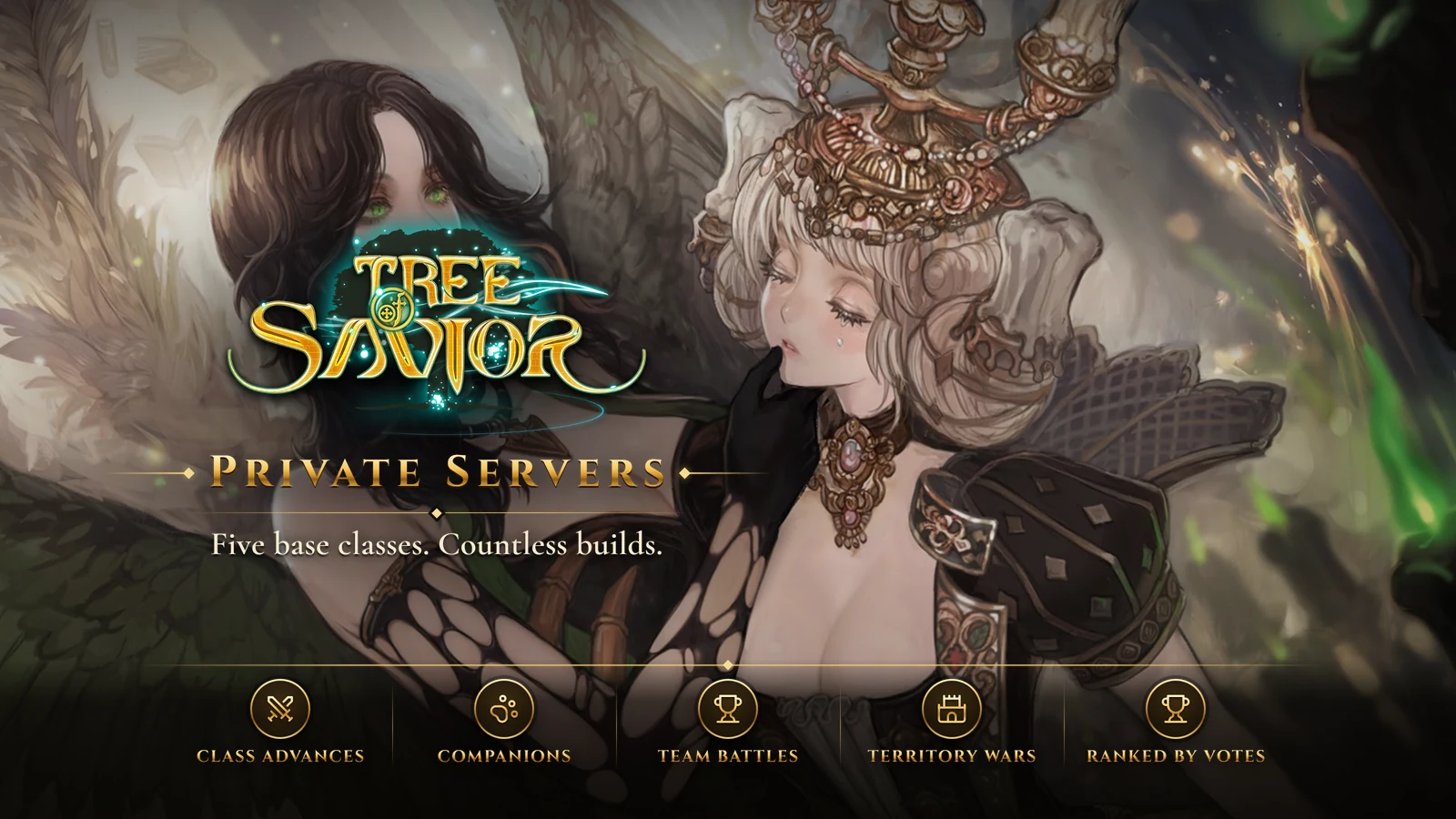
Tree of Savior is IMC Games' storybook-style MMORPG, produced by Kim Hakkyu, the designer behind Ragnarok Online, and released internationally on Steam in 2016. It carries a lot of Ragnarok's spirit: a soundtrack by SoundTeMP, a hand-drawn look, and a class tree so large that planning your build is half the game. The official international version is still running and still adding classes, so private servers here offer a different version of the game rather than the only way to play it.
Players who look for a Tree of Savior private server usually want something the live game no longer offers - the original rank system from before the Re:Build overhaul, friendlier rates, or a smaller community where the economy starts fresh. This guide covers what to check.
Builds Are the Game
You start in one of five base classes - Swordsman, Wizard, Archer, Cleric or Scout - and advance into further classes from that tree, ending up with a combination that is yours. The sheer number of combinations is why people still talk about the game: a Wizard line can lean into ice, summoning, time magic or support depending on which advanced classes you add, and some classes only unlock through hidden requirements. Build planners and long forum guides are a normal part of playing.
Around the builds sits a classic MMO frame: dungeons and field bosses, boss cards and gems that slot into your gear, companions such as the Velheider and the Hoglan, and PvP through the Team Battle League and Guild Territory Wars. Leveling is long, and the class you pick at each step changes the rest of the run.
What to Look For in a Tree of Savior Private Server
Pre-Re:Build or Current Client
This is the biggest split. The official game replaced its original rank-and-circle progression, where some classes could be taken up to three circles deep, with a simpler structure of a base class plus three advanced classes. Players who miss the old builds look for servers on an older client; others prefer the newer classes and balance. Check which client a server runs before you plan anything, because build guides from one era do not work in the other.
How Complete the Server Is
Fan-run Tree of Savior servers rest on emulator work, and emulating a game with this many classes and skills takes years. Some skills, quests and dungeons may be missing or behave differently from the original. Look for a clear list of what works, and test the classes in your build early instead of finding a broken skill at the end of a long leveling run.
Rates and Leveling Pace
Every class step in Tree of Savior costs time. Mid rates tend to suit the game best: fast enough that trying a new build is not a month-long commitment, slow enough that dungeons and field bosses still matter. Check EXP, drop and card rates separately, since a server can be quick to level and still slow to gear.
Class Resets and Balance
With this many classes, some will outperform others on any server. Look at how the server handles class and stat resets and whether the team adjusts balance over time. A server that lets you rebuild without starting a new character makes experimenting far less painful.
Shop Policy and Population
The official game sells premium currency and convenience items. On a private server, check what the shop offers and whether the same items can be earned in play. Team Battle League and territory wars also need enough people online at the same hours, so check the community's size and main time zone.
Getting Started
Choose the client era first, then plan a build with tools made for that version. Level one character to its first advanced class before you commit to a server; by then you will know whether your skills work and whether people are around. If a server earns your time, vote for it. The ranking below lists the Tree of Savior servers players vote for here, and it starts again every month.
Top Tree of Savior Private Servers (2026)
No Tree of Savior private servers are listed yet. Servers added to the site appear here, ranked by this month's player votes.
Frequently Asked Questions
What is the best Tree of Savior private server in 2026?
No Tree of Savior private server is listed here yet. The first ones to be added appear in the ranking on this page, ordered by this month's votes.
How many Tree of Savior private servers are there?
None are listed here yet. A Tree of Savior private server added to the site appears in this ranking as soon as it is active.
How often are these rankings updated?
The ranking is read live from this month's vote counts, so it changes as players vote. Its order last changed on October 13, 2026.
How We Rank Tree of Savior Servers
Servers are listed by the number of counted votes they received this month, most first. Each player can vote for a server once every 24 hours, and every vote is checked for VPNs, proxies and bots before it counts. Vote counts start again from zero on the 1st of every month, and a server that goes 14 days without a counted vote is hidden from the lists until it gets one. Player reviews and ratings are shown on each server's page but do not change its position. How rankings work has the full rules.
- Ordered by this month's counted votes
- One vote per server every 24 hours
- VPN, proxy and bot checks on every vote
- A fresh start on the 1st of every month